
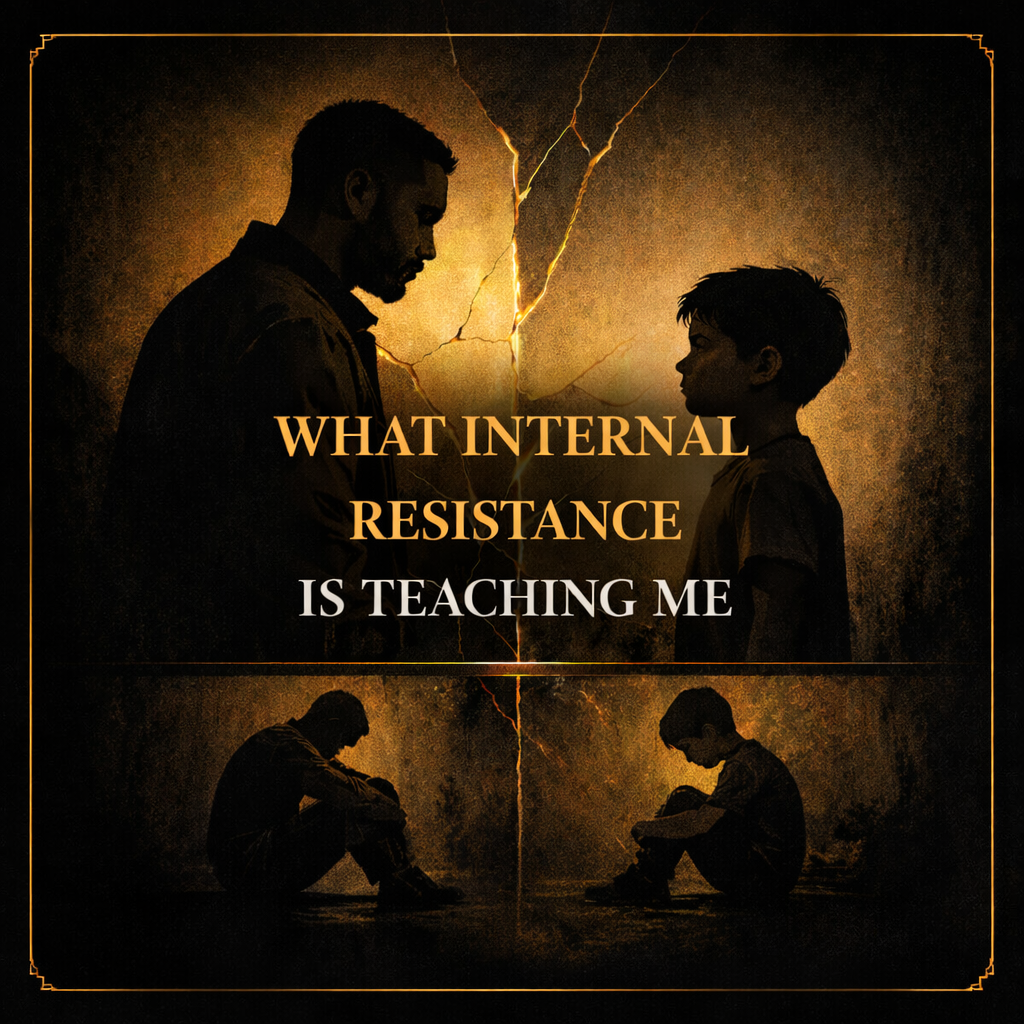
There’s a kind of resistance that keeps surfacing in my life, and it doesn’t look dramatic. It doesn’t sabotage my calendar or erase my ambition. It shows up more subtly—in hesitation, in defensiveness that feels slightly disproportionate, in moments where I feel the urge to withdraw instead of engage. I’ve noticed that whenever I begin stepping into a new level of growth—spiritually, emotionally, professionally—something inside me tightens.
For a long time, I interpreted that tightening as inconsistency. A discipline issue. Maybe even immaturity.
Recently, through counseling, I’ve begun to understand that it may be something deeper.
Unresolved trauma from childhood.
The Hinge Point Reality
One concept that shifted my perspective was what my counselor called “hinge points.” The idea is straightforward but profound: when you experience trauma at a certain age and never process it, if a current situation triggers that same emotional wound, you don’t respond as your present age. You respond as the age you were when the trauma happened.
That reframed a lot for me.
There have been moments when my reactions felt bigger than the situation warranted. Moments when criticism felt like rejection, when conflict felt like abandonment, when pressure felt like threat. Intellectually, I knew the circumstances weren’t catastrophic. But emotionally, my body reacted as if they were.
That disconnect wasn’t random. It was a hinge point.
In those moments, I wasn’t just a grown man responding to present reality. I was also the younger version of myself whose pain was never fully processed.
When Resistance Is Protection
What I’m learning is that internal resistance isn’t always laziness or pride. Sometimes it’s protection. Sometimes it’s the nervous system doing what it learned to do years ago in order to survive. If a wound formed at eight, twelve, or fifteen and was never metabolized, the nervous system doesn’t care that decades have passed. It remembers the pattern. And when something even vaguely resembles that old pain, it activates the same emotional response.
That realization has forced me to stop shaming myself for certain reactions. Instead of asking, “What’s wrong with me?” I’m asking, “What is this reminding me of?” Instead of labeling myself as overly sensitive or reactive, I’m trying to trace the reaction back to its origin.
Internal resistance may not be the enemy. It may be a signal.
You Cannot Outrun What You Won’t Process
There’s a temptation to believe that ambition can override pain. That if I build enough, achieve enough, discipline myself enough, the past will dissolve on its own.
It doesn’t work that way.
You cannot outrun trauma with productivity. You cannot bury it under purpose. You cannot silence it with spiritual language. If it’s unprocessed, it will resurface. And often it resurfaces in the places that matter most—marriage, parenting, leadership, calling. The very areas where maturity is required are the areas where unresolved pain becomes most visible.
Survival Strategies That Outlived Their Usefulness
Another humbling realization is that some of my current tendencies may have once been necessary. Hyper-independence. Guarded communication. Emotional intensity. These weren’t random personality traits; they may have been survival strategies.
At some point in my life, those responses protected me.
But survival strategies that go unchecked can sabotage growth. What once shielded you can later isolate you. What once kept you safe can later keep you distant. Maturity isn’t about shaming the strategy—it’s about updating it.
The environment changed. I have to change with it.
Responding From My Current Age
The work now is learning to respond as the man I am today, not the boy who was hurt.
That requires awareness. It requires pausing in heated moments and asking, “How old do I feel right now?” It requires noticing when my body is reacting faster than my logic. It requires the discipline to slow down before I speak, withdraw, or escalate.
This isn’t about eliminating triggers. It’s about recognizing them.
It’s about realizing that growth isn’t just adding new habits or setting new goals. It’s excavating old wounds so they no longer dictate present behavior.
What It’s Teaching Me
The resistance that keeps showing up is teaching me that evolution requires courage—not just to build, but to feel. Not just to move forward, but to revisit what froze me in place. It’s teaching me that some of my present behaviors may be rooted in past pain. And if I want to lead well, love well, and live with clarity, I cannot ignore that connection. I don’t write this from a place of full resolution. I write it from awareness.
And awareness is the beginning of transformation.
Internal resistance isn’t proof that I’m failing. It may be proof that I’m approaching something that needs healing. And if I want the next level of my life to be stable, not just impressive, I have to do the internal work.
That’s the lesson.
And I’m committed to learning it.
