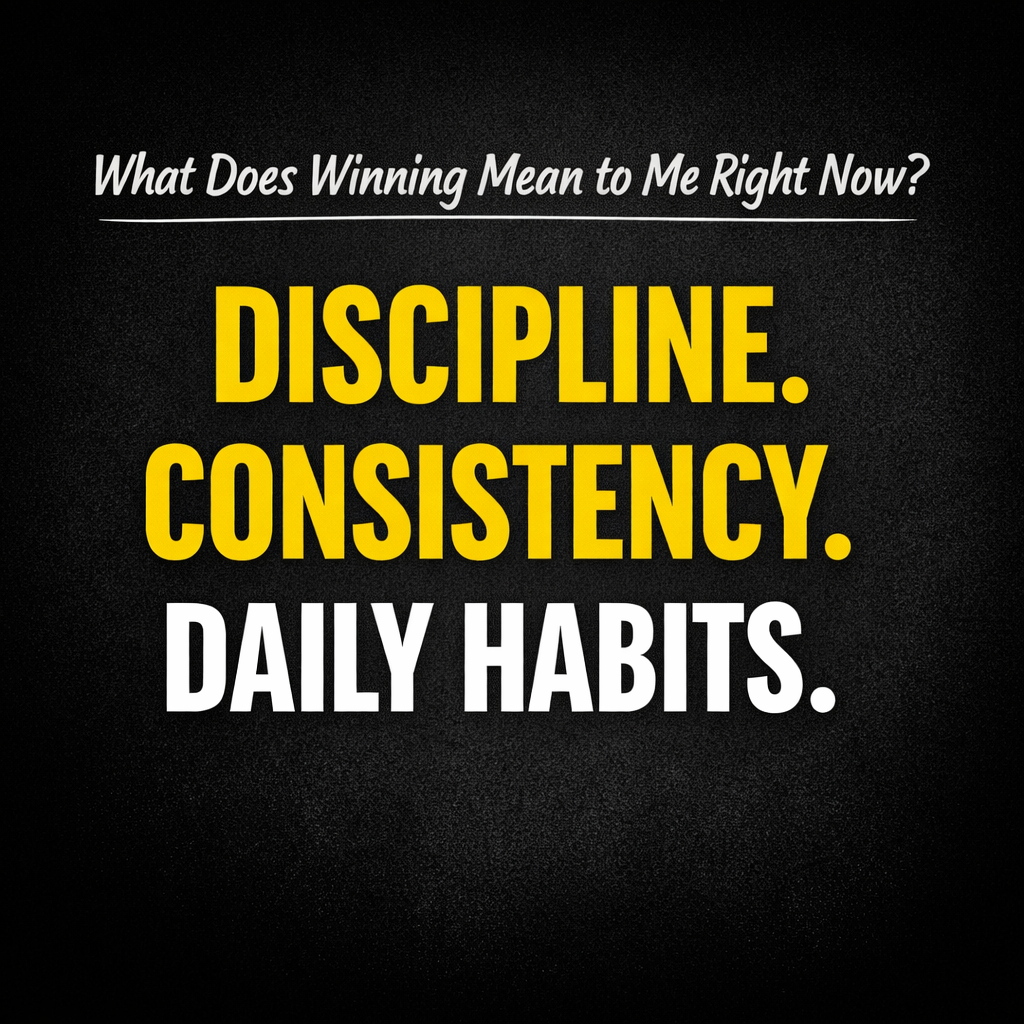
What Does Winning Actually Mean to Me Right Now?

In this season of my life, winning looks like discipline.

I have a lot of goals—personal, professional, spiritual—but the most pressing thing on my spirit right now isn’t the outcome. It’s the process. Specifically, my ability to be disciplined and consistent with my daily routine.

I’ve come to understand something very clearly: Anything I want to accomplish will be accomplished if I can master discipline and consistency.

I once read a simple idea that stuck with me: how you live your day is how you live your life. Your days don’t disappear—they stack. And over time, those repeated actions turn into habits. Those habits create direction. And that direction becomes your life.

So when I ask myself what winning looks like right now, it isn’t followers. It isn’t notoriety. It isn’t fame.
And it isn’t even money.

Because money without discipline doesn’t last. Success without structure eventually collapses. A lack of discipline in one area always bleeds into others.

Winning, for me, looks like consistency.

Consistency in my marriage—how I show up, how I communicate, how I listen. Consistency in fatherhood—my presence, my patience, my leadership. Consistency in my personal health—fitness, diet, mental clarity. Consistency at work—showing up prepared, focused, and accountable.

That’s winning.

Not perfection—but measurable progress. Not intensity—but repeatability.

There are areas of my life where I already operate with discipline and consistency. And there are other areas where I know things need to tighten up. I’m honest about that. I’m constantly self-assessing—not from a place of shame, but from a place of responsibility.

Because I want to be able to look at my life and see the evidence.

There’s a quote that captures all of this for me:

“Discipline is the bridge between goals and accomplishment.”

Right now, crossing that bridge—every day—is what winning actually means to me.
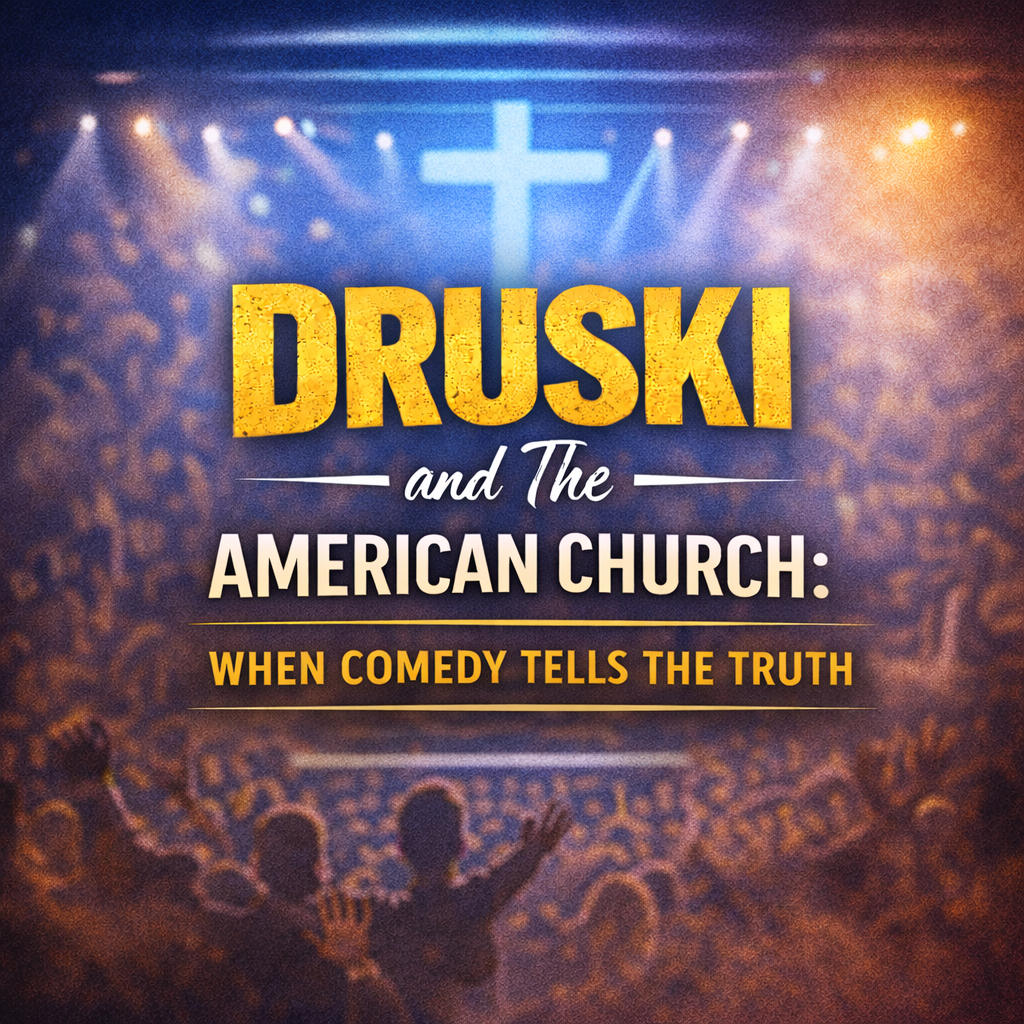
Druski and the American Church: When Comedy Tells the Truth

Recently, a viral video by Druski sparked a level of cultural reaction few moments ever reach—hundreds of millions of views, millions of comments, and widespread debate across social media. The video openly mocked familiar practices associated with modern megachurch culture—performative spirituality, celebrity pastors, emotional manipulation, and the blurred line between faith and entertainment.

Many were offended. But offense alone is not proof of error.

What made this moment different is simple: the satire worked because it pointed at something real.

Comedy as a Mirror, Not an Attack

Great comedians have always done one thing well—they expose truth by exaggeration. They don’t invent cultural flaws; they highlight them. The discomfort people feel is often proportional to how close the joke lands to reality.

If the behaviors being mocked did not exist, the joke would have fallen flat. Instead, it resonated because many believers—quietly and privately—have witnessed these same patterns for decades.

This wasn’t mockery of Christ.
It was mockery of counterfeit representations of Him.

Scripture Anticipated This Moment

The Bible is not silent about religious posturing or distorted faith.

Paul describes a group whose spirituality looks convincing on the surface but is empty at its core:

“Their end is destruction, their god is their belly, and they glory in their shame, with minds set on earthly things.”
Philippians 3:19

This isn’t atheism being described.
It’s misdirected religion—faith driven by appetite, image, power, and gain.

Elsewhere, Scripture warns:

“See to it that no one takes you captive by philosophy and empty deceit, according to human tradition…”
Colossians 2:8

What was mocked in that viral moment wasn’t holiness.
It was human tradition masquerading as divine authority.

God Uses Unexpected Voices

One of the most uncomfortable truths for religious people is this:
God is not limited to insiders.

Throughout Scripture, God repeatedly uses outsiders, critics, and even adversaries to expose corruption among His own people. Truth does not lose its authority because of the messenger.

In this case, a comedian became a cultural mirror—forcing millions to ask, “Is that what church is supposed to look like?”

That question alone is a win for truth.

This Separates the Real From the Fake

Jesus Himself said:

“You will recognize them by their fruits.”
Matthew 7:16

Moments like this help people see the difference between:

  • The true Church (a people formed by repentance, humility, and obedience)

  • And religious theater (built on charisma, control, and consumption)

If someone watches that video and thinks, “That doesn’t look like what Jesus taught,” then discernment has already begun.

The Responsibility Now Falls on Believers

The response should not be outrage.
It should be embodiment.

If false versions of faith are exposed, then it becomes the responsibility of true believers to:

  • Live with integrity

  • Teach the Word without manipulation

  • Practice holiness without performance

  • Love without spectacle

The early church was recognized not by lights, stages, or personalities—but by devotion, sacrifice, and truth (Acts 2:42–47).

Conclusion: Truth Is Not the Enemy of the Gospel

What threatens the gospel is not exposure.
What threatens it is imitation without substance.

If satire helps people distinguish between the real and the counterfeit, then—even unintentionally—it has served a redemptive purpose.

The answer is not to silence critics.
The answer is to be the Church Christ actually described.

When the real is lived openly, the fake eventually collapses on its own.

The Power of Resilience

Life has a way of testing our limits. Unexpected challenges, painful losses, and sudden setbacks can leave us feeling overwhelmed, broken, and uncertain about the future. But there’s a force within each of us — often dormant until it’s needed most — that enables us to rise, rebuild, and move forward. That force is resilience.

Resilience isn't about avoiding pain or pretending hardships don’t hurt. It's about acknowledging the storm, standing firm in the rain, and believing that the sun will shine again. It’s about choosing faith over fear, determination over defeat, and hope over hopelessness.

When we look back over our lives, we realize that it wasn't the easy moments that shaped us. It was the battles we fought, the tears we cried, and the nights we prayed for strength. Each trial became a stepping stone, each scar a testimony, each comeback a reminder that God is not finished with us yet.

Resilience is a Gift From God

Resilience is more than just human strength — it’s a divine gift. It’s the whisper that says, “Get up. Keep going. I’m not through with you.” Every time we’ve fallen but found the courage to rise again, that was God breathing new life into our spirit. Every time we thought we were done but somehow discovered fresh strength, that was a reminder: Thank God I Am Alive.

How to Cultivate Resilience in Your Life

  1. Stay Grounded in Faith Resilience is rooted in knowing that no matter how bad today looks, God holds tomorrow. Trusting in His promises gives us the courage to endure.

  2. Embrace the Process Healing, growth, and restoration take time. Don’t rush the journey. Let every experience, even the painful ones, build deeper strength within you.

  3. Speak Life Over Yourself Your words matter. Even when you feel weak, declare strength. Speak hope when you feel hopeless. Affirm that you are being strengthened even in the struggle.

  4. Lean on Community You were never meant to fight alone. Surround yourself with people who remind you of who you are and whose you are.

  5. Keep Moving Forward Progress isn’t always pretty or fast, but every small step is a victory. Resilience is built one decision, one prayer, and one act of courage at a time.

Your Story Is Not Over

If you are reading this today, it means you have survived every battle you thought would break you. You have endured what others thought would destroy you. You have outlived every storm that tried to silence you. You are living proof that resilience is real.

So today, pause for a moment. Take a deep breath. Look back at how far you’ve come and say with full conviction:

"Thank God I Am Alive."

And then, lift your head high and walk forward — stronger, wiser, and more resilient than ever before.

How Gratitude Can Transform Your Life

There’s something powerful about a “thank you”—not just the words, but the spirit behind them. Gratitude isn’t just a polite gesture or a feel-good emotion; it’s a transformative force that can reshape your mindset, strengthen your spirit, and shift the entire direction of your life.

When we choose to live in a posture of gratitude, we take back control of our perspective. Life may not always go how we planned, but gratitude reminds us that even in chaos, there are constants—things we can still be thankful for. It teaches us to see past temporary discomfort and appreciate lasting lessons. And that shift alone can open doors to deeper peace, sharper clarity, and greater resilience.

Gratitude also changes how we relate to others. It softens our judgments, mends broken bridges, and allows us to lead with love rather than lack. When we express appreciation to the people in our lives, we create space for deeper connection and mutual respect. Gratitude builds bridges—between people, between past and present, between where you are and where you’re going.

It’s also a powerful antidote to bitterness. You can’t be resentful and grateful at the same time. Gratitude purifies the heart, recalibrates the mind, and brings joy back into places that once felt heavy. Even in seasons of struggle, there’s always something to give thanks for—breath in your lungs, lessons learned, strength gained, or simply the fact that you woke up one more day to try again.

If you want a better life, don’t wait for everything to be perfect. Start by giving thanks for what you already have. The more you appreciate it, the more you’ll find to be grateful for.

Let gratitude lead, and watch your life be transformed.

Affirmation of the Week: “I choose gratitude over grumbling. I see blessings even in brokenness. I am thankful, and I am transformed.”

#ThankGodIAmAlive

Lessons From Life’s Toughest Moments

There’s something about pain that makes you pause.

It makes you reflect. It makes you reassess. And if you’re paying attention, it makes you grow.

Life’s toughest moments have a strange way of shaping us into the people we were always meant to be. They don’t come with warning signs or easy exits, but somehow—through the fire—we come out refined.

I’ve faced some dark days. Moments where hope felt distant, where I questioned everything—my purpose, my strength, and yes, even my faith. But I’m still here. And if you're reading this… so are you.

Here are just a few of the lessons I’ve learned while walking through the valleys:

1. Your Breaking Point Is Also Your Building Point

I used to see breakdowns as weakness. But now I see them as the moment something new gets built. Sometimes God has to let things fall apart so He can rebuild them better—with a stronger foundation and a higher ceiling.

2. Pain is a Teacher, Not a Punishment

I stopped asking, “Why is this happening to me?” and started asking, “What is this trying to teach me?” That shift in perspective changed everything. Tough moments don’t come to destroy us—they come to grow us.

3. Isolation Reveals Identity

Some of the hardest seasons felt the loneliest. But those were the seasons I discovered who I really was. Stripped of applause, support, or distraction, I was forced to sit with myself—and with God. In that silence, I heard truth louder than ever before.

4. Gratitude is Grit in Disguise

Being thankful when everything is going right is easy. But when you can whisper “thank you” through tears and pain? That’s power. That’s resilience. And that’s how you fight your way back into the light.

5. Your Scars Are Someone Else’s Roadmap

We don’t just survive for ourselves. We survive for others. Someone out there is walking a path you’ve already walked—and your story might just be the encouragement they need to keep going. Your pain wasn’t in vain. It has purpose.

If you’re in the middle of a hard season right now, I want to remind you: you are not alone. You have made it through 100% of your toughest days thus far. Every storm runs out of rain. And even in the darkest night, God is present, powerful, and working.

He’s not done with you.

So take a deep breath, hold on to hope, and say it with me:

“Thank God I’m alive.”