You Are Allowed to Evolve

There is a quiet pressure that follows growth.

It whispers that who you were yesterday must be who you remain today. That because you said something, believed something, built something, or represented something at one stage of your life, you are required to defend it forever.

That pressure is not truth. It is fear disguised as consistency.

You are allowed to evolve.

Evolution does not mean you were fake before. It means you were faithful to the level of awareness you had at the time. Growth simply means your awareness has expanded. When awareness expands, alignment must adjust. And when alignment adjusts, identity shifts.

Most people don’t resist change because they lack information. They resist change because they fear losing approval. They fear disappointing the version of themselves that once felt certain. They fear what others will say when the pivot becomes visible.

But stagnation is more dangerous than criticism.

If you stay where you’ve outgrown, you will slowly disconnect from yourself. The conversations will feel forced. The routines will feel mechanical. The goals will feel heavy instead of meaningful. That tension is not confusion—it’s a signal.

It’s a hinge point.

A hinge point is that moment where life quietly asks:

Will you protect the old version of yourself, or will you step into the next one?

You don’t drift into evolution. You choose it.

You choose to read differently.

You choose to think differently.

You choose to discipline your body differently.

You choose to speak differently.

You choose to build differently.

And eventually, you become different.

The key is this: evolution requires release.

You may need to release outdated beliefs.

You may need to release old environments.

You may need to release coping mechanisms that once protected you but now limit you.

You may even need to release titles or labels that no longer fit.

That release can feel like loss. But it is not loss. It is pruning. And pruning is necessary for strength.

The version of you that survives the pruning is sharper, clearer, and more intentional.

Understand this: growth will disrupt comfort. It may disrupt relationships. It may disrupt business models. It may disrupt how people categorize you.

That is not failure. That is refinement.

The world will try to freeze you in a single snapshot. But you are not a snapshot. You are a trajectory.

If you feel internal resistance right now, don’t automatically interpret it as weakness. Ask what it’s revealing. Sometimes resistance shows you where you’re avoiding the work. Other times it shows you where you’ve outgrown the space.

Discern the difference.

Evolution is not about becoming someone new for applause. It is about becoming more aligned with truth.

And alignment requires courage.

So today, give yourself permission.

Permission to change your mind.

Permission to update your standards.

Permission to pursue something that feels more aligned than what once did.

Permission to leave what no longer fits.

You are not betraying your past.

You are building on it.

Growth is not disloyalty to who you were.

It is loyalty to who you are becoming.

And that version of you is waiting on a decision.

You are allowed to evolve.

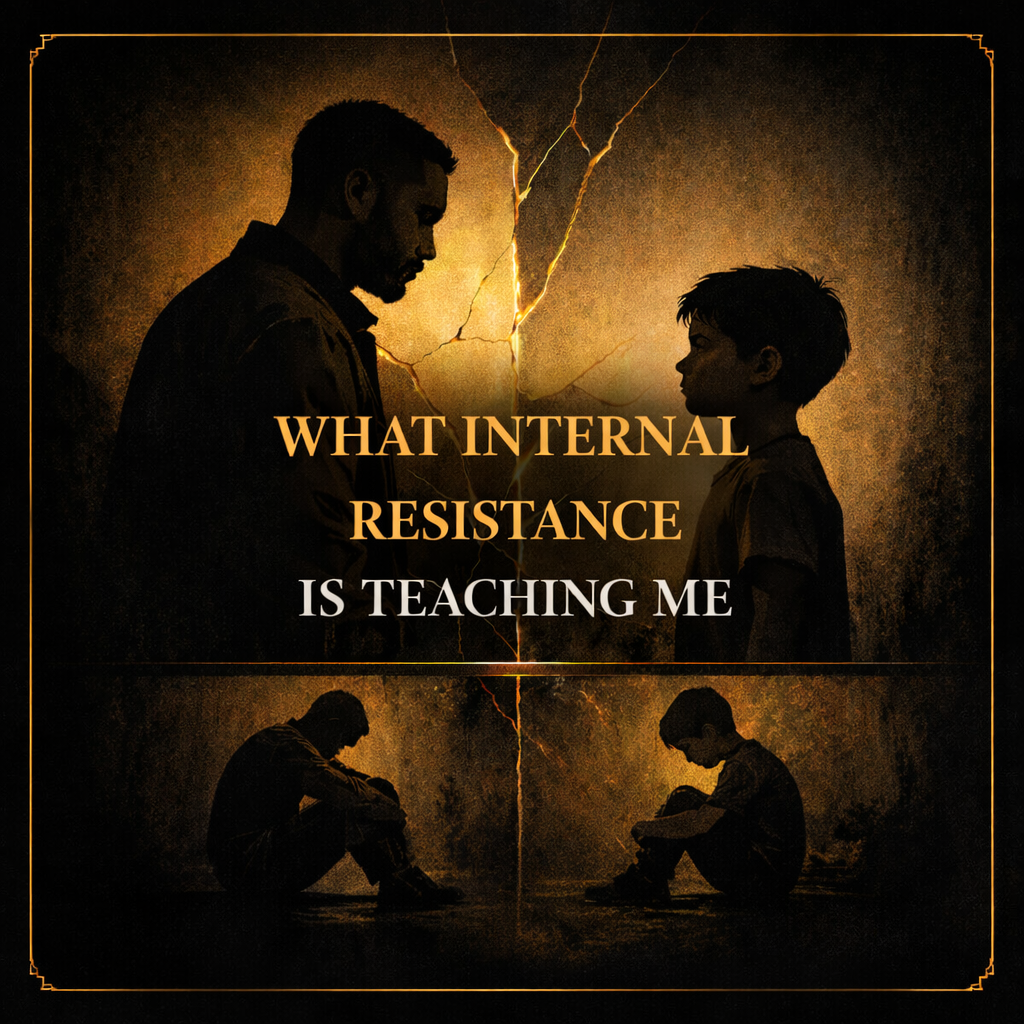
What Internal Resistance Is Teaching Me

There’s a kind of resistance that keeps surfacing in my life, and it doesn’t look dramatic. It doesn’t sabotage my calendar or erase my ambition. It shows up more subtly—in hesitation, in defensiveness that feels slightly disproportionate, in moments where I feel the urge to withdraw instead of engage. I’ve noticed that whenever I begin stepping into a new level of growth—spiritually, emotionally, professionally—something inside me tightens.

For a long time, I interpreted that tightening as inconsistency. A discipline issue. Maybe even immaturity.

Recently, through counseling, I’ve begun to understand that it may be something deeper.

Unresolved trauma from childhood.

The Hinge Point Reality

One concept that shifted my perspective was what my counselor called “hinge points.” The idea is straightforward but profound: when you experience trauma at a certain age and never process it, if a current situation triggers that same emotional wound, you don’t respond as your present age. You respond as the age you were when the trauma happened.

That reframed a lot for me.

There have been moments when my reactions felt bigger than the situation warranted. Moments when criticism felt like rejection, when conflict felt like abandonment, when pressure felt like threat. Intellectually, I knew the circumstances weren’t catastrophic. But emotionally, my body reacted as if they were.

That disconnect wasn’t random. It was a hinge point.

In those moments, I wasn’t just a grown man responding to present reality. I was also the younger version of myself whose pain was never fully processed.

When Resistance Is Protection

What I’m learning is that internal resistance isn’t always laziness or pride. Sometimes it’s protection. Sometimes it’s the nervous system doing what it learned to do years ago in order to survive. If a wound formed at eight, twelve, or fifteen and was never metabolized, the nervous system doesn’t care that decades have passed. It remembers the pattern. And when something even vaguely resembles that old pain, it activates the same emotional response.

That realization has forced me to stop shaming myself for certain reactions. Instead of asking, “What’s wrong with me?” I’m asking, “What is this reminding me of?” Instead of labeling myself as overly sensitive or reactive, I’m trying to trace the reaction back to its origin.

Internal resistance may not be the enemy. It may be a signal.

You Cannot Outrun What You Won’t Process

There’s a temptation to believe that ambition can override pain. That if I build enough, achieve enough, discipline myself enough, the past will dissolve on its own.

It doesn’t work that way.

You cannot outrun trauma with productivity. You cannot bury it under purpose. You cannot silence it with spiritual language. If it’s unprocessed, it will resurface. And often it resurfaces in the places that matter most—marriage, parenting, leadership, calling. The very areas where maturity is required are the areas where unresolved pain becomes most visible.

Survival Strategies That Outlived Their Usefulness

Another humbling realization is that some of my current tendencies may have once been necessary. Hyper-independence. Guarded communication. Emotional intensity. These weren’t random personality traits; they may have been survival strategies.

At some point in my life, those responses protected me.

But survival strategies that go unchecked can sabotage growth. What once shielded you can later isolate you. What once kept you safe can later keep you distant. Maturity isn’t about shaming the strategy—it’s about updating it.

The environment changed. I have to change with it.

Responding From My Current Age

The work now is learning to respond as the man I am today, not the boy who was hurt.

That requires awareness. It requires pausing in heated moments and asking, “How old do I feel right now?” It requires noticing when my body is reacting faster than my logic. It requires the discipline to slow down before I speak, withdraw, or escalate.

This isn’t about eliminating triggers. It’s about recognizing them.

It’s about realizing that growth isn’t just adding new habits or setting new goals. It’s excavating old wounds so they no longer dictate present behavior.

What It’s Teaching Me

The resistance that keeps showing up is teaching me that evolution requires courage—not just to build, but to feel. Not just to move forward, but to revisit what froze me in place. It’s teaching me that some of my present behaviors may be rooted in past pain. And if I want to lead well, love well, and live with clarity, I cannot ignore that connection. I don’t write this from a place of full resolution. I write it from awareness.

And awareness is the beginning of transformation.

Internal resistance isn’t proof that I’m failing. It may be proof that I’m approaching something that needs healing. And if I want the next level of my life to be stable, not just impressive, I have to do the internal work.

That’s the lesson.

And I’m committed to learning it.

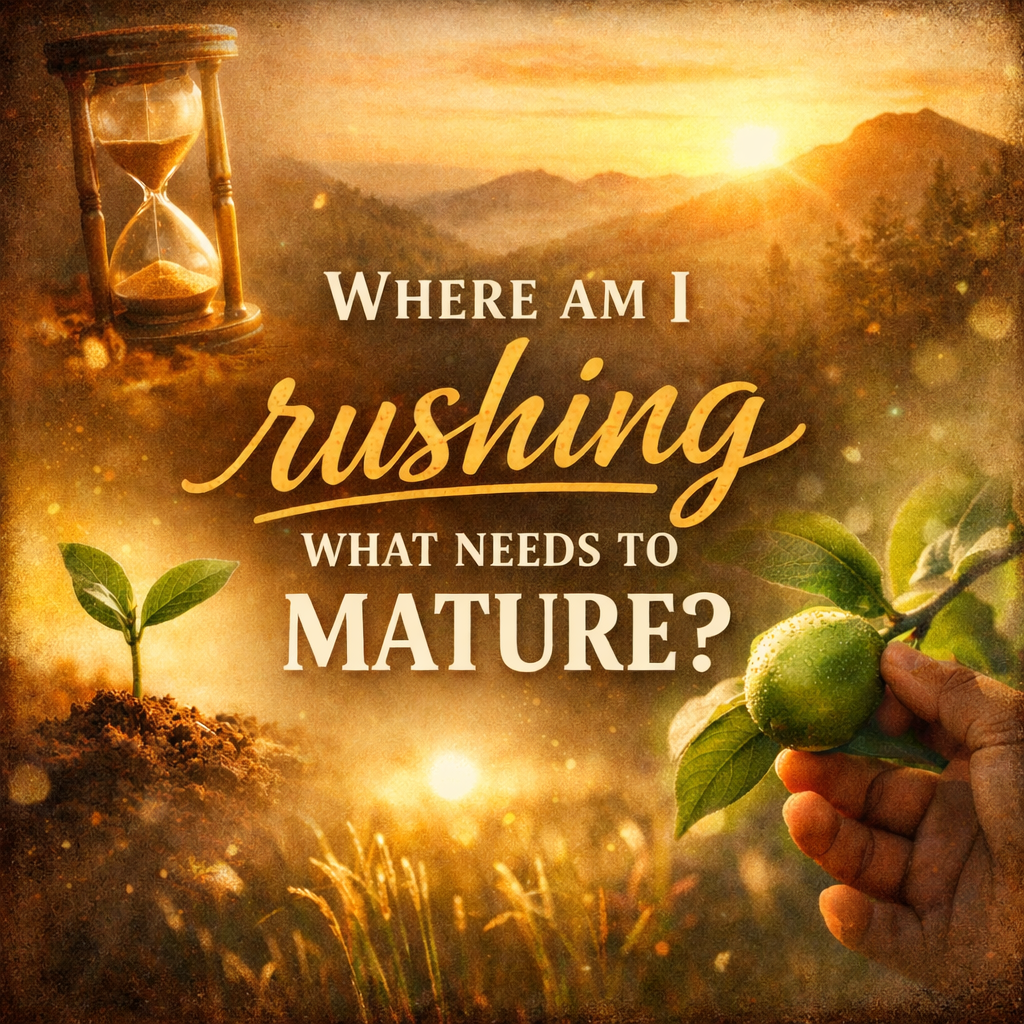
Where Am I Rushing What Needs to Mature?

There’s a difference between momentum and impatience. I’ve been thinking a lot about that lately.

I’m wired to move. I like progress. I like execution. I like seeing ideas turn into results. For most of my life, that drive has served me well. It’s helped me build, rebuild, and pivot when necessary. But there’s a quieter question that’s been pressing on me:

Where am I rushing what needs to mature?

Not everything that’s slow is stagnant.
Not everything that’s delayed is denied.
And not everything that resists acceleration is meant to be forced.

The Cost of Premature Movement

We live in a culture that rewards speed. Launch fast. Grow fast. Scale fast. Post daily. Monetize early. Announce before you’re ready. The problem is that speed without depth creates fragility.

When something hasn’t had time to mature, it may look ready on the surface—but it won’t be rooted.

I’ve rushed things before:

  • Ideas that needed refinement, not exposure

  • Conversations that needed patience, not pressure

  • Seasons that needed presence, not escape

Each time, the outcome was the same: extra friction, unnecessary repair work, and lessons that could’ve been learned with less damage if I had slowed down.

Maturity Is Quiet Work

Maturity doesn’t announce itself. It develops in silence.

Roots grow underground.
Muscles strengthen during rest.
Wisdom forms through repetition, not revelation.

There are areas of life where the work isn’t to do more—it’s to stay longer.

  • Stay in the discipline before demanding the outcome

  • Stay in the process before expecting the harvest

  • Stay teachable before claiming mastery

Rushing maturity is like pulling fruit before it’s ripe. You don’t get nourishment—you get something that looks right but doesn’t taste right.

Why We Rush

When I’m honest, rushing usually comes from one of three places:

  1. Fear of being behind
    Comparison creates artificial urgency. Someone else’s timeline starts dictating my decisions.

  2. Discomfort with the in-between
    The middle season is awkward. You’re no longer who you were, but you’re not yet who you’re becoming. That tension tempts you to skip steps.

  3. Control disguised as ambition
    Sometimes rushing is just an attempt to manage outcomes instead of stewarding the process.

None of those produce maturity. They produce motion—but not growth.

What Needs Time Right Now?

This question isn’t abstract. It’s practical.

Where am I trying to force clarity instead of allowing understanding to form?
Where am I demanding results before consistency has done its work?
Where am I announcing things that should still be incubating?

Some things in my life don’t need a push. They need protection.
They don’t need exposure. They need development.
They don’t need validation. They need patience.

The Discipline of Letting Things Ripen

There’s discipline in restraint.

It takes maturity to say:

  • “Not yet.”

  • “I’m still learning.”

  • “This deserves more time.”

The strongest builders aren’t the fastest starters—they’re the ones who respect foundations. They understand that what’s rushed may rise quickly, but what’s matured lasts.

So instead of asking, “How do I speed this up?” I’m learning to ask, “What is this season actually for?”

Because every season has a purpose:

  • Preparation before promotion

  • Formation before function

  • Depth before reach

Closing Reflection

Rushing doesn’t make something ready.
Time, intention, and obedience do.

If something in your life feels resistant, it may not be opposition—it may be instruction. A signal to slow down. To tend. To mature.

The goal isn’t to arrive faster.
The goal is to arrive whole.

So I’ll keep moving—but not ahead of the work that needs to happen in me first.

What Does Winning Actually Mean to Me Right Now?

In this season of my life, winning looks like discipline.

I have a lot of goals—personal, professional, spiritual—but the most pressing thing on my spirit right now isn’t the outcome. It’s the process. Specifically, my ability to be disciplined and consistent with my daily routine.

I’ve come to understand something very clearly: Anything I want to accomplish will be accomplished if I can master discipline and consistency.

I once read a simple idea that stuck with me: how you live your day is how you live your life. Your days don’t disappear—they stack. And over time, those repeated actions turn into habits. Those habits create direction. And that direction becomes your life.

So when I ask myself what winning looks like right now, it isn’t followers. It isn’t notoriety. It isn’t fame.
And it isn’t even money.

Because money without discipline doesn’t last. Success without structure eventually collapses. A lack of discipline in one area always bleeds into others.

Winning, for me, looks like consistency.

Consistency in my marriage—how I show up, how I communicate, how I listen. Consistency in fatherhood—my presence, my patience, my leadership. Consistency in my personal health—fitness, diet, mental clarity. Consistency at work—showing up prepared, focused, and accountable.

That’s winning.

Not perfection—but measurable progress. Not intensity—but repeatability.

There are areas of my life where I already operate with discipline and consistency. And there are other areas where I know things need to tighten up. I’m honest about that. I’m constantly self-assessing—not from a place of shame, but from a place of responsibility.

Because I want to be able to look at my life and see the evidence.

There’s a quote that captures all of this for me:

“Discipline is the bridge between goals and accomplishment.”

Right now, crossing that bridge—every day—is what winning actually means to me.

Druski and the American Church: When Comedy Tells the Truth

Recently, a viral video by Druski sparked a level of cultural reaction few moments ever reach—hundreds of millions of views, millions of comments, and widespread debate across social media. The video openly mocked familiar practices associated with modern megachurch culture—performative spirituality, celebrity pastors, emotional manipulation, and the blurred line between faith and entertainment.

Many were offended. But offense alone is not proof of error.

What made this moment different is simple: the satire worked because it pointed at something real.

Comedy as a Mirror, Not an Attack

Great comedians have always done one thing well—they expose truth by exaggeration. They don’t invent cultural flaws; they highlight them. The discomfort people feel is often proportional to how close the joke lands to reality.

If the behaviors being mocked did not exist, the joke would have fallen flat. Instead, it resonated because many believers—quietly and privately—have witnessed these same patterns for decades.

This wasn’t mockery of Christ.
It was mockery of counterfeit representations of Him.

Scripture Anticipated This Moment

The Bible is not silent about religious posturing or distorted faith.

Paul describes a group whose spirituality looks convincing on the surface but is empty at its core:

“Their end is destruction, their god is their belly, and they glory in their shame, with minds set on earthly things.”
Philippians 3:19

This isn’t atheism being described.
It’s misdirected religion—faith driven by appetite, image, power, and gain.

Elsewhere, Scripture warns:

“See to it that no one takes you captive by philosophy and empty deceit, according to human tradition…”
Colossians 2:8

What was mocked in that viral moment wasn’t holiness.
It was human tradition masquerading as divine authority.

God Uses Unexpected Voices

One of the most uncomfortable truths for religious people is this:
God is not limited to insiders.

Throughout Scripture, God repeatedly uses outsiders, critics, and even adversaries to expose corruption among His own people. Truth does not lose its authority because of the messenger.

In this case, a comedian became a cultural mirror—forcing millions to ask, “Is that what church is supposed to look like?”

That question alone is a win for truth.

This Separates the Real From the Fake

Jesus Himself said:

“You will recognize them by their fruits.”
Matthew 7:16

Moments like this help people see the difference between:

  • The true Church (a people formed by repentance, humility, and obedience)

  • And religious theater (built on charisma, control, and consumption)

If someone watches that video and thinks, “That doesn’t look like what Jesus taught,” then discernment has already begun.

The Responsibility Now Falls on Believers

The response should not be outrage.
It should be embodiment.

If false versions of faith are exposed, then it becomes the responsibility of true believers to:

  • Live with integrity

  • Teach the Word without manipulation

  • Practice holiness without performance

  • Love without spectacle

The early church was recognized not by lights, stages, or personalities—but by devotion, sacrifice, and truth (Acts 2:42–47).

Conclusion: Truth Is Not the Enemy of the Gospel

What threatens the gospel is not exposure.
What threatens it is imitation without substance.

If satire helps people distinguish between the real and the counterfeit, then—even unintentionally—it has served a redemptive purpose.

The answer is not to silence critics.
The answer is to be the Church Christ actually described.

When the real is lived openly, the fake eventually collapses on its own.